Blog
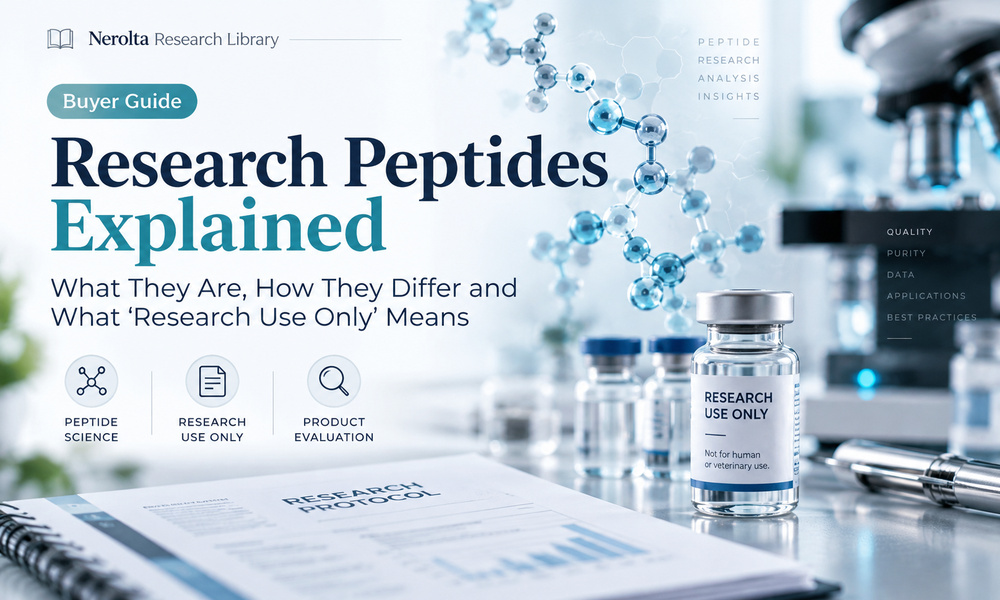
Research Peptides Explained: What They Are, How They Differ and What “Research Use Only” Means


Updated October 2026 • 5 min read • Peptide-focused visuals aligned with Nerolta packaging
Research peptides are defined as much by market context and documentation as by the molecule name itself.
RUO credibility depends on the whole page and supplier behavior, not just one disclaimer.
This topic should function as a hub that routes readers into supplier, quality and compound-specific pages.
The phrase research peptides has become one of the most commercially important entry points into the peptide market. It sits close to buyer intent because people using the term are often not looking for general biology alone. They want to understand what kind of products exist, how they should be evaluated and how research-use-only compounds differ from finished therapeutic products.
A research peptide is best understood as a peptide material supplied in a laboratory research context. That sounds straightforward, but a lot depends on how the supplier documents, labels and presents the material. The term has value only if it is connected to clear identity, traceability and responsible research-use framing.
What makes a peptide a research peptide?
In the market, the phrase usually signals that a peptide is being offered for laboratory or in vitro work rather than as a consumer supplement or a regulated finished medicine. But the label alone is not enough. A strong research-peptide listing should also include coherent product identity, lot-level thinking, documentation support and language consistent with research use.
This matters because search behavior often moves from general curiosity to product comparison within a single session. A person may start by searching research peptides and very quickly move toward compound-specific or supplier-specific evaluation.

Research peptides vs approved peptide drugs
This distinction is essential. An approved drug product exists within a regulatory framework for human therapeutic use. A research peptide, by contrast, is positioned for laboratory investigation. The molecular name may overlap, but the product category, documentation expectations and claims environment are different.
That is why buyers should be cautious with pages that collapse the difference. Strong supplier content acknowledges the scientific literature and the underlying molecule while keeping the marketed material within a research-use context.
What “research use only” means in practice
Research use only, or RUO, is part of responsible product positioning. It helps signal that the compound is supplied for laboratory and investigational contexts. In practice, RUO credibility is reinforced by the entire page experience: the way the product is described, whether analytical or traceability signals are present, and whether claims remain aligned with research use.
Pages that rely on one disclaimer while using otherwise inappropriate promotional language undermine that credibility. That is why RUO should be understood as an operational principle, not just a footer phrase.
What buyers should compare when evaluating research peptides
- Identity clarity: is the compound named consistently?
- Research-only framing: is the page written for laboratory use rather than consumer-medical promotion?
- Traceability: can the material be connected to a lot or batch?
- Analytical context: are purity, identity and testing discussed coherently?
- Broader supplier quality: does the site show signs of a real research operation?
These are the checks that transform a general keyword article into a commercial asset. Someone searching research peptides is often close to comparing suppliers, and content should help them make a more disciplined decision.
How this page fits into a larger SEO strategy
This topic works best as a hub. It should send readers into more specific pages like how to choose a research peptide supplier, what research grade means, purity vs content and compound-specific guides across the catalog. Done well, it captures commercial-intent traffic while building authority for the entire research library.
Turn category knowledge into better buying decisions
Readers using the phrase research peptides are often already evaluating where to buy or how to compare suppliers. That makes this guide a bridge between education and procurement.
The best next step is to compare actual products and deeper quality guides side by side.
- Use this page to understand the category, then move into product-specific evaluation.
- Check RUO positioning together with traceability and analytical signals.
- Treat the catalog as a research resource, not just a list of names.
Why this matters for a laboratory buyer: the research question and the procurement decision should connect cleanly. A product page should make it easy to verify identity, presentation, current price and available batch information without relying on exaggerated outcome claims.
Before you order: make the product page part of the research record
Open the exact Nerolta listing and compare the compound name, current presentation, supplied form, storage wording, price and any available batch documentation against your laboratory SOP before purchasing.
After purchase, archive the order confirmation, lot identifier and supporting documentation with the experiment record. That creates a cleaner chain from literature review to procurement and makes reorders, troubleshooting and cross-lot comparisons easier.
Browse the catalog
Open the current catalog to compare research compounds and continue deeper into Nerolta’s research library.
Browse compoundsSupplier guide
Frequently asked questions
Are research peptides the same as peptide drugs?
No. They may share molecular names in some cases, but the market category, intended context and documentation expectations are different.
What should a good research-peptide supplier show?
Clear product identity, traceability, research-use framing and documentation that supports the legitimacy of the material being offered.
Why is this keyword commercially important?
Because users searching it are often already evaluating suppliers or moving quickly toward procurement decisions.
Explore the research peptide catalog
Use this category guide as a starting point, then compare specific research compounds and deeper quality guides across the Nerolta library.