
Blog
What Does “Research Grade” Mean for Peptides? A Quality Framework for Laboratory Buyers

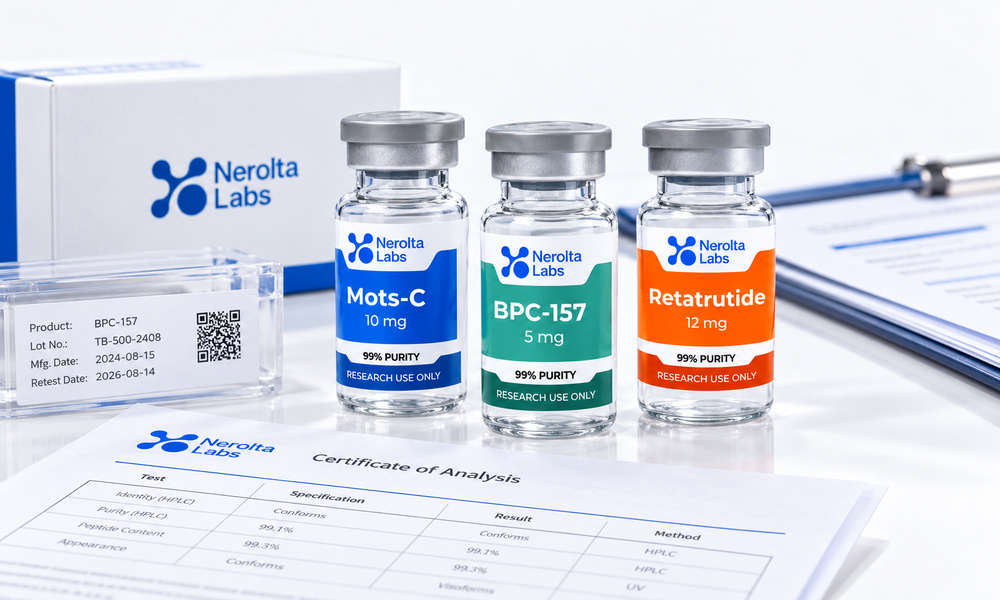
Updated October 2026 • 6 min read • Peptide-focused visuals aligned with Nerolta packaging
“Research grade” is a descriptive phrase, not a complete analytical specification.
Identity, purity, content, lot traceability and handling documentation answer separate quality questions.
A defensible buying decision relies on specific evidence rather than badges or adjectives.
“Research grade” appears throughout laboratory-supply catalogs, but the phrase is not a complete specification. Two suppliers can use the same words while applying different analytical methods, purity targets, documentation practices and manufacturing controls. For a laboratory buyer, the label should therefore start a due-diligence process rather than end it.
A more useful question is: what measurable evidence supports this specific batch?
Turn a grade label into measurable attributes
Peptide quality is multidimensional. Identity, purity, content, physical form, batch consistency and stability are different attributes. A single adjective cannot replace them.
Reference-standard work in peptide science illustrates this principle clearly: well-characterized material can require multiple analytical techniques to establish identity, content, impurities and stability. Research buyers do not necessarily need the same regulatory package as a pharmaceutical reference standard, but the analytical logic is valuable.

1. Identity: is it the intended compound?
Identity asks whether the material corresponds to the intended peptide. Mass spectrometry is commonly used because the expected molecular mass can be calculated from sequence and compared with measured signals. Depending on the material and laboratory, other orthogonal methods may also be used.
2. Purity: how clean is the analytical profile?
HPLC or UPLC is commonly used to separate the sample and report relative chromatographic purity. A high value can be useful, but researchers should remember that chromatographic purity is not the same as net peptide content by weight. Our purity versus content guide explains the distinction.
3. Traceability: does the evidence match the vial?
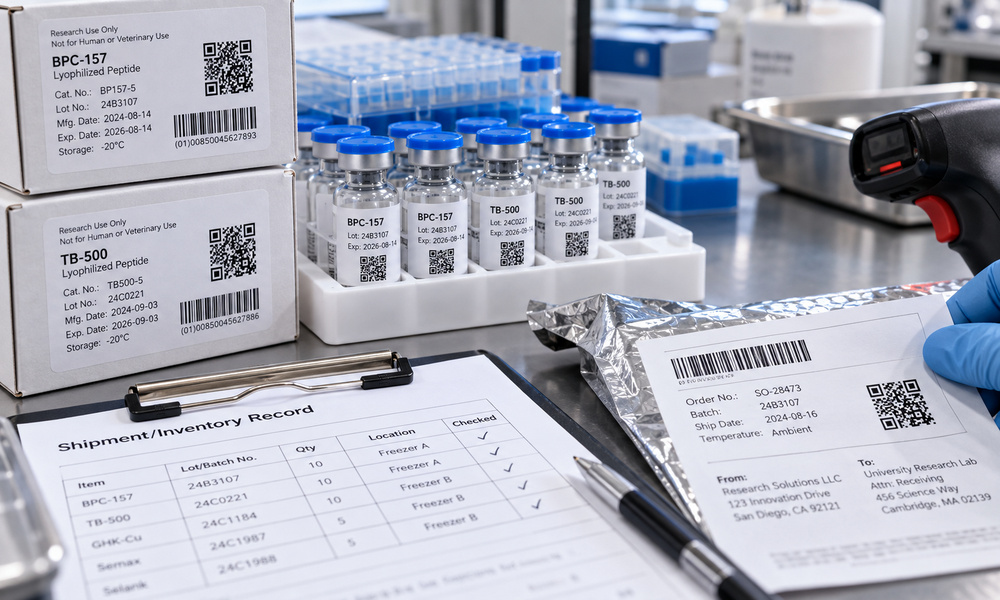
A COA should identify the lot it describes. Without a lot match, even excellent analytical data cannot be confidently assigned to the physical material in the laboratory. Batch traceability is therefore one of the simplest and most valuable procurement checks.
4. Method transparency: what was actually measured?
A report that says “tested” without naming the test communicates very little. Researchers should be able to identify whether a number comes from HPLC, MS, a quantitative assay or another technique. Different methods support different conclusions.
What “Research Use Only” does and does not tell you
Research-use labeling establishes an intended laboratory context. It should not be interpreted as a therapeutic approval, nor should it be taken as independent proof of purity. A supplier can label a material for research use and still need to substantiate the analytical claims made about that material.
Conversely, a research-use product can be extensively characterized. The point is that intended-use language and analytical quality are separate dimensions.
A practical buyer framework
| Check | Question to ask |
|---|---|
| Identity | What evidence supports the compound identity? |
| Purity | What method produced the purity result? |
| Batch | Does the COA lot match the vial lot? |
| Content | Is net peptide content relevant and, if so, was it measured? |
| Documentation | Can the laboratory archive the record with the experiment? |
Why this framework improves experiments
Better procurement data strengthens reproducibility. When a result changes between experiments, researchers can distinguish biological variability from a change in material source or batch. When a method is published, future investigators have a clearer record of what was actually used.
That is a stronger definition of quality than relying on “premium,” “high purity” or “research grade” without evidence.
Words that sound precise but still need evidence
Terms such as “premium,” “ultra pure,” “high purity” and “research grade” can all be useful catalog shorthand, but none substitutes for a batch record. A laboratory buyer should be able to translate marketing language into a measurable question. “High purity” becomes “what method and what result?” “Verified” becomes “verified by whom, on which lot, using what test?”
This mindset is especially useful in research peptides because different suppliers can use similar front-end language while providing very different levels of documentation.
Build a procurement record that survives the purchase
Quality evaluation should not end when an order arrives. Save the COA, lot number, receipt date, supplier and product presentation with the experimental record. If the study is repeated using a later batch, record that change explicitly. This makes it possible to interpret batch-to-batch variation rather than discovering after the fact that the material changed.
A disciplined procurement trail is one of the simplest ways to make laboratory research more reproducible. It also creates a clearer basis for conversations with a supplier if a result needs investigation.
Turn “research grade” from a label into a buying checklist
The phrase “research grade” is useful only when it leads to verifiable details. A qualified buyer should be able to move from that broad label to the compound identity, lot number, stated analytical methods, purity result, supplied form and any available batch documentation. If the phrase is the end of the quality conversation, it is doing marketing work rather than scientific work.
This framework also gives Nerolta a clearer sourcing path. Instead of asking readers to trust a slogan, the article can invite them to open a current product listing and test it against the same checklist. Transparent product identity and pricing are easier to evaluate when the buyer already knows which quality claims require evidence.
- Use the product name and lot as the anchors for every supporting document.
- Separate identity evidence, chromatographic purity and any quantitative content claim rather than bundling them under one “grade.”
- Capture the supplied form and storage information because reproducibility begins before the assay starts.
Why this matters for a laboratory buyer: the research question and the procurement decision should connect cleanly. A product page should make it easy to verify identity, presentation, current price and available batch information without relying on exaggerated outcome claims.
Before you order: make the product page part of the research record
Open the exact Nerolta listing and compare the compound name, current presentation, supplied form, storage wording, price and any available batch documentation against your laboratory SOP before purchasing.
After purchase, archive the order confirmation, lot identifier and supporting documentation with the experiment record. That creates a cleaner chain from literature review to procurement and makes reorders, troubleshooting and cross-lot comparisons easier.
Put the research-grade checklist to work
Browse Nerolta’s catalog and evaluate the current product listings using the identity, testing and traceability questions in this guide.
Explore research compoundsRead the supplier guide
Frequently asked research questions
Does “research grade” guarantee a specific purity percentage?
Not by itself. The useful evidence is the stated specification and the batch-specific analytical result supporting it.
Is research-use labeling the same as analytical quality?
No. Intended-use language and analytical characterization are separate. A research-only label does not by itself prove identity, purity or content.
What is the fastest way to evaluate a research peptide listing?
Check whether the supplier connects the product to a lot, names the analytical methods, distinguishes identity from purity and provides documentation that can be archived with the experiment.
Evaluate Nerolta research compounds by documentation
Browse the research catalog, compare product specifications and keep batch information with your laboratory records.


One thought on “What Does “Research Grade” Mean for Peptides? A Quality Framework for Laboratory Buyers”
Comments are closed.