Blog
Are Peptides Legal? U.S. Research Peptide Rules and Regulations Explained


Updated October 2026 • 5 min read • Peptide-focused visuals aligned with Nerolta packaging
Peptide legality depends on the category, the claims being made and the market context.
RUO positioning should be supported by the whole page experience, not just one disclaimer.
Legality and supplier quality are closely linked in real buyer behavior.
The question are peptides legal sounds simple, but it is not a yes-or-no question. “Peptides” is a broad category that includes naturally occurring biomolecules, regulated therapeutic drugs, investigational substances and research-use-only materials sold for laboratory work. Legality depends on which of those categories is actually being discussed and how the material is represented in the market.
For laboratory buyers, the most important distinction is between a research compound and a regulated finished drug product. A supplier who sells a peptide for laboratory and in vitro work should not market that material as if it were an approved medicine, and buyers should treat that difference as more than a legal technicality. It affects claims, labeling, documentation and risk.
Why the word “peptides” creates legal confusion
The search query itself bundles together several distinct markets. A person may be asking about legal access to a prescribed drug, the sale of a research chemical, or the legality of general peptide supplements. Because the query is broad, a useful article should first unpack the category before trying to answer the legal part.
For research suppliers, the key issue is representation. When a peptide is supplied for research use, the supplier’s language, documentation and product presentation should stay aligned with that context. Unclear or aggressive claims can create the appearance that a research product is being sold as something it is not.
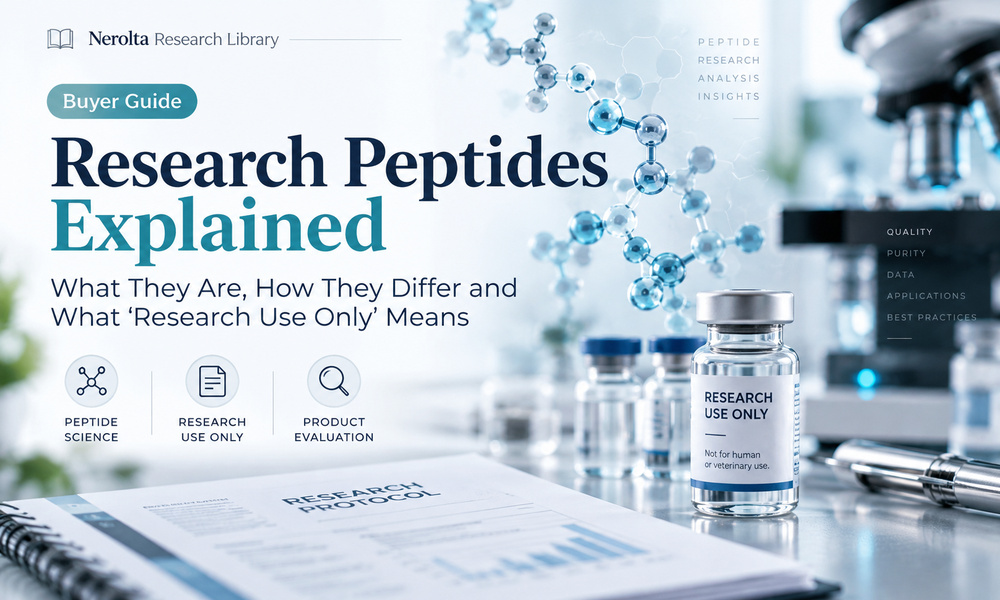
Research-use-only positioning matters
Research-use-only, often shortened to RUO, is not just a marketing phrase. It is part of how a supplier communicates the intended context of a material. Pages that explain laboratory use responsibly, avoid human-use claims and maintain analytical and traceability records are generally showing a more credible understanding of the category.
By contrast, red-flag behavior may include dosing language, treatment promises, vague sourcing statements or branding that blurs the line between laboratory material and approved therapy. That is one reason the legality question overlaps strongly with supplier evaluation.
What buyers should look at when evaluating legality and legitimacy
- Claims: Are the claims framed around research or around treatment and outcomes?
- Documentation: Is there traceability, analytical support and transparent product identification?
- Product presentation: Does the page look like a research listing or like a disguised consumer-medical offer?
- Consistency: Do labels, descriptions and supporting material all point to the same context?

Why legality and quality often get discussed together
Researchers searching are peptides legal are often also trying to answer a second question: is this supplier operating responsibly? That is why the best commercial content does not stop at a legal abstraction. It shows how responsible positioning connects to lot traceability, analytical support and sourcing transparency.
Our own guidance on choosing a research peptide supplier and peptide lot traceability expands on that practical side. Legal confidence is rarely created by one statement alone. It comes from the full pattern of how a supplier presents and documents the material.
Common myths
- Myth: If something is called a peptide, the legal answer is always the same.
Reality: category and representation matter. - Myth: RUO wording alone solves everything.
Reality: the entire sales page, not just one line, affects the credibility of the positioning. - Myth: legality has nothing to do with documentation.
Reality: documentation supports the legitimacy and traceability of the research material being offered.
Move from legal curiosity to supplier-level verification
Researchers who ask whether peptides are legal often need to make a sourcing decision next. That decision is safer and smarter when legality is paired with documentation and transparency checks.
Use the legal question as an entry point, then compare actual supplier behavior before ordering.
- Check how the product is framed, not just whether a disclaimer exists.
- Prefer suppliers who connect product identity to traceable documentation.
- Use legal caution and analytical discipline together, not separately.
Why this matters for a laboratory buyer: the research question and the procurement decision should connect cleanly. A product page should make it easy to verify identity, presentation, current price and available batch information without relying on exaggerated outcome claims.
Before you order: make the product page part of the research record
Open the exact Nerolta listing and compare the compound name, current presentation, supplied form, storage wording, price and any available batch documentation against your laboratory SOP before purchasing.
After purchase, archive the order confirmation, lot identifier and supporting documentation with the experiment record. That creates a cleaner chain from literature review to procurement and makes reorders, troubleshooting and cross-lot comparisons easier.
Review research compounds with supplier context
Browse Nerolta’s research compounds and compare their presentation with the supplier-evaluation criteria discussed above.
Browse compoundsSupplier guide
Frequently asked questions
Are all peptides legal to buy?
No single answer covers every peptide. The category is broad, and the legal context depends on the type of material and how it is being sold or represented.
What does research-use-only really mean?
It means the product is positioned for laboratory or in vitro research rather than for therapeutic, diagnostic or consumer use.
How can buyers reduce legal and quality risk?
By working with suppliers who maintain clear research-use positioning, transparent documentation and lot-specific traceability.
Compare supplier transparency before sourcing
If the legality question brought you here, the next useful step is evaluating how a supplier presents and documents research compounds in practice.