Blog
Retatrutide vs Tirzepatide vs Semaglutide in 2026: Receptors, Evidence and Trial Maturity

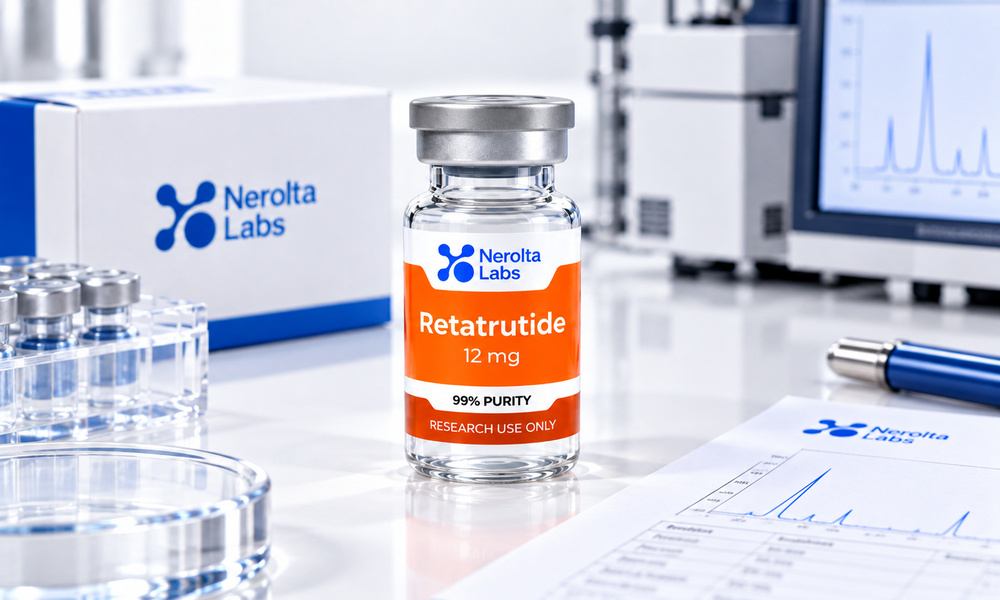
Updated October 2026 • 6 min read • Peptide-focused visuals aligned with Nerolta packaging
Semaglutide, tirzepatide and retatrutide target different numbers of receptors.
Results from separate trials are not equivalent to a randomized head-to-head comparison.
As of October 2026, retatrutide remains investigational while its phase 3 evidence base continues to mature.
“Retatrutide vs tirzepatide vs semaglutide” has become one of the most visible comparison searches in the incretin field. The problem is that many comparisons collapse three different questions into one: which receptors each molecule targets, how mature the evidence is, and what individual trials reported. Those questions should be separated before any meaningful comparison is made.
As of October 2026, semaglutide and tirzepatide are established FDA-approved medicines with large phase 3 programs and current U.S. prescribing information. Retatrutide remains investigational. At the same time, retatrutide’s evidence base changed materially in late September 2026 when phase 3 data were published and presented. That makes older comparison pages easy to misread if they still describe retatrutide as having only phase 2 evidence.
Quick comparison: one receptor, two receptors and three receptors
| Compound | Primary receptor design | U.S. status, Oct. 2026 |
|---|---|---|
| Semaglutide | GLP-1 receptor agonist | FDA-approved products exist |
| Tirzepatide | GIP + GLP-1 receptor agonist | FDA-approved products exist |
| Retatrutide | GIP + GLP-1 + glucagon receptor agonist | Investigational; not FDA-approved |
This receptor count is the cleanest conceptual difference. Semaglutide is built around one receptor family. Tirzepatide adds GIP receptor activity to GLP-1 receptor activity. Retatrutide adds a third target, the glucagon receptor. The extra target does not make a clinical conclusion automatic; it changes the pharmacology that researchers need to measure.

What changed for retatrutide in 2026?
Retatrutide entered 2026 with strong interest but an evidence base that many comparison pages still described mainly through phase 2. That framing is now incomplete. A phase 3 randomized trial, TRIUMPH-1, was published in the New England Journal of Medicine on September 29, 2026. Lilly also reported additional phase 3 data across the broader retatrutide program.
This does not erase the regulatory distinction. Lilly continues to describe retatrutide as investigational and not FDA-approved. The scientifically useful update is therefore not “retatrutide has replaced the others.” It is that the evidence-maturity gap has narrowed in specific trial settings while approval status remains different.
Why trial percentages should not be turned into a simple ranking
A common comparison method places the largest reported percentage from one retatrutide study beside the largest reported percentage from a tirzepatide or semaglutide study and declares a winner. That is not a head-to-head experiment. Trial populations, inclusion criteria, durations, background disease, estimands, discontinuation rules and endpoint handling can differ.
Cross-trial context can be educational, but it should be labeled as cross-trial context. A direct randomized comparison is methodologically stronger because the competing interventions are tested inside the same trial framework. Until such data exist for a particular pair and question, separate programs should not be treated as if they were one experiment.

Semaglutide: the single-receptor reference point
Semaglutide activates the GLP-1 receptor and has become a reference point because its clinical-development and regulatory history are mature. FDA labeling for Wegovy identifies semaglutide as a GLP-1 receptor agonist. For research comparisons, that provides a useful single-receptor baseline against which dual and triple agonist designs can be described.
Tirzepatide: dual GIP and GLP-1 receptor agonism
Tirzepatide adds GIP receptor agonism to GLP-1 receptor agonism. FDA labeling for Zepbound describes that dual receptor profile. Researchers comparing tirzepatide with retatrutide should therefore focus on the additional glucagon-receptor component in retatrutide rather than treating the compounds as interchangeable versions of the same molecule.
Retatrutide: triple agonism and an evolving evidence base
Retatrutide is a single molecule engineered to activate GIP, GLP-1 and glucagon receptors. The glucagon-receptor arm is what differentiates the triple-agonist design from tirzepatide’s dual-agonist design. It is also why the informal “GLP-3” label is scientifically misleading: the third target is the glucagon receptor, not a receptor called GLP-3.
For a deeper explanation of that naming issue, read Is GLP-3 a Real Receptor?. For a retatrutide-specific evidence overview, see Retatrutide Research in 2026.
What this comparison means for laboratory research
- Define the molecule precisely. Receptor class is not enough to establish vial identity.
- Separate clinical evidence from material characterization. Published trial results do not verify a third-party research vial.
- Match the lot to the analytical record. Identity, purity and traceability remain separate quality questions.
- Record evidence maturity. Approved status, phase 3 publication and preclinical evidence are different categories.
- Avoid unsupported rankings. A cross-trial comparison should not be rewritten as a head-to-head result.
Researchers evaluating analytical documentation can use Nerolta’s guides to HPLC versus LC-MS and batch traceability as a quality framework.
Use receptor comparison to make the next research decision more precise
Comparison searches often begin with a simple “which is better?” question, but a laboratory project needs a more exact answer: which receptor profile and evidence base match the hypothesis being tested? Semaglutide, tirzepatide and retatrutide differ in receptor targets and in the maturity of their evidence. Those differences should guide model selection and comparator design before they influence procurement.
If the project specifically requires retatrutide, the practical next step is to verify the current research listing rather than turning clinical trial headlines into assumptions about a supplier vial. Use the product page for presentation, price and research-use details; use the scientific literature for pharmacology and evidence. Keeping those roles separate makes the purchase more defensible and the resulting methods section easier to reproduce.
- Choose comparators based on the receptor question the experiment needs to isolate.
- Do not rank compounds from headline percentages without accounting for trial design, population and evidence maturity.
- When sourcing retatrutide research material, record the exact listing, lot and available analytical documentation independently of clinical-trial evidence.
Why this matters for a laboratory buyer: the research question and the procurement decision should connect cleanly. A product page should make it easy to verify identity, presentation, current price and available batch information without relying on exaggerated outcome claims.
Before you order: make the product page part of the research record
Open the exact Nerolta listing and compare the compound name, current presentation, supplied form, storage wording, price and any available batch documentation against your laboratory SOP before purchasing.
After purchase, archive the order confirmation, lot identifier and supporting documentation with the experiment record. That creates a cleaner chain from literature review to procurement and makes reorders, troubleshooting and cross-lot comparisons easier.
Need retatrutide for qualified laboratory research?
Review Nerolta’s current GLP-3 Reta / Retatrutide listing and compare the supplied presentation with the experimental question defined in this guide.
View Retatrutide research compoundBrowse the research catalog
Frequently asked research questions
Is retatrutide the same as tirzepatide?
No. Tirzepatide is a dual GIP/GLP-1 receptor agonist. Retatrutide is a triple GIP/GLP-1/glucagon receptor agonist.
Is retatrutide FDA-approved in 2026?
No. Lilly continues to describe retatrutide as investigational and not FDA-approved as of October 2026.
Can separate clinical trials prove which molecule is “better”?
No. Separate trials can provide context, but different populations and designs prevent them from functioning as a direct randomized head-to-head comparison.
Explore Retatrutide research material
Review Nerolta Labs Retatrutide / GLP-3 Reta research-use information and current product specifications.
References & further reading
- Retatrutide, a Triple Hormone Receptor Agonist, for Treatment of Obesity — NEJM (2026)
- Lilly: What to know about retatrutide — updated September 2026
- FDA prescribing information: Wegovy (semaglutide), 2026
- FDA prescribing information: Zepbound (tirzepatide)